A large ME/CFS research project has been awarded € 7.5 million in funding by the European Commission. The project is led by Professors Eva Untersmayr and Simon Carding and will harmonize five European biobanks to further the discovery and validation of ME/CFS biomarkers. This article gives more context and background about this historic step for ME/CFS research in Europe.
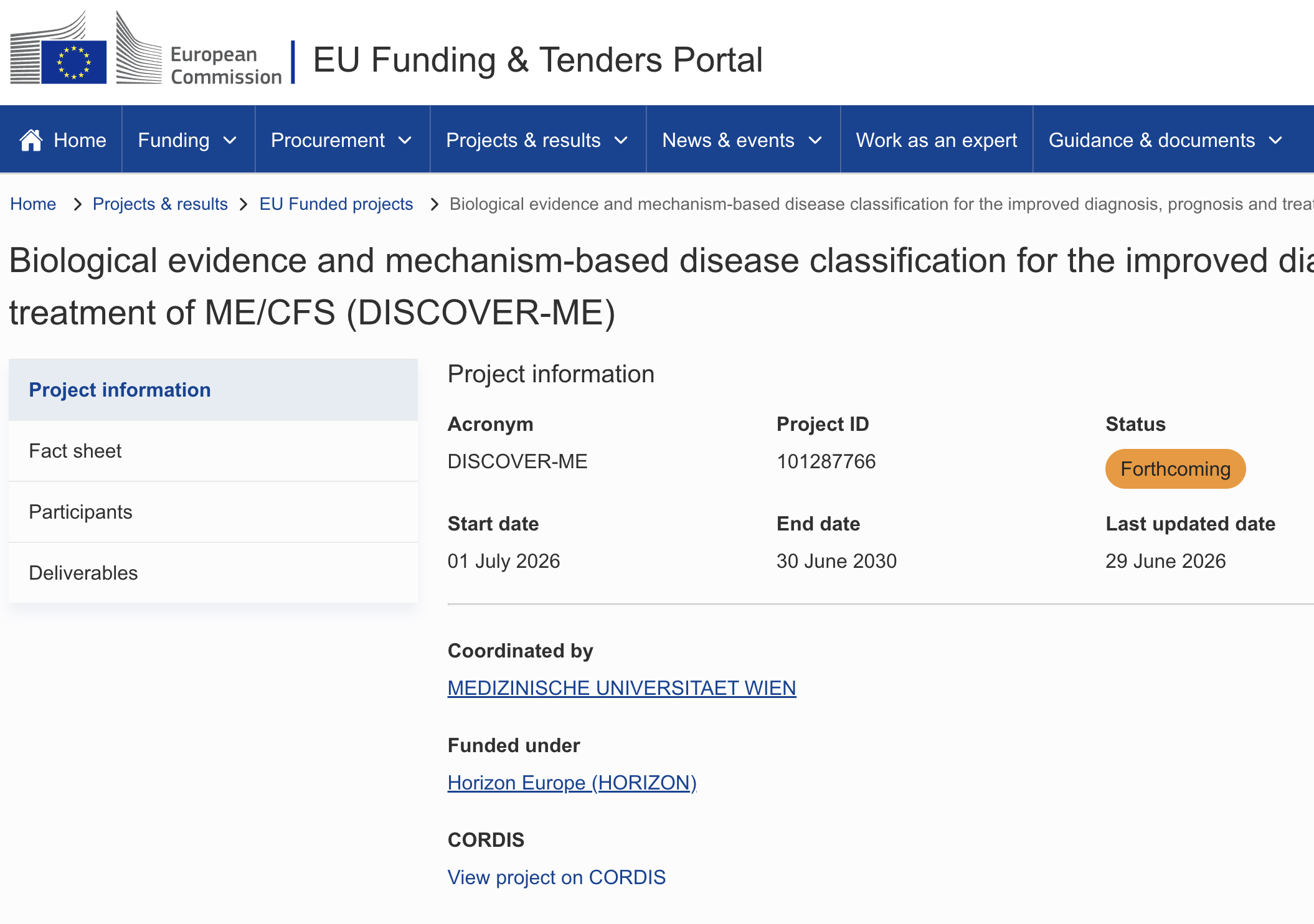
The ME/CFS consortium is named “DISCOVER-ME” and includes 21 partners and research groups spread across Europe and North America. The project is led by Prof. Eva Untersmayr at the Medical University of Vienna and Simon Carding from the Quadram Institute. The European ME Alliance (EMEA) is involved as patient organisation. The project aims to study 2000 patients and conduct multi-omics analyses on more than 900 samples from five European biobanks. It will identify and validate biomarkers across (epi)genetic, immune, metabolic, neuroendocrine, and vascular domains. It received a budget of € 7.5 million for a period of 4 years, making it one of the largest ME/CFS projects ever. You can read more about the project here.
The grant has been awarded through Horizon Europe, the major research initiative by the European Union. This is a highly competitive program where more than 90% of applications are rejected. When we started our advocacy work at the European level in 2018, it was believed that these big grants were unattainable for ME/CFS researchers. However, significant progress has been made over the last couple of years.
From the petition to the first call
A European petition calling for biomedical research was launched in 2019 and reached more than 14.000 signatures. Members of the European Parliament (MEPs) were contacted and informed about the illness. A year later, in 2020, the European Parliament adopted a resolution that called on the Commission and Member States to allocate funding for biomedical research on ME/CFS and ensure due recognition of the disease. A parliamentary interest group on ME/CFS, spearheaded by Belgian MEP Pascal Arimont, pressured the Commission to follow up on these commitments. An open letter signed by more than one hundred scientists highlighted that Europe was lagging behind in supporting ME/CFS research. Something had to be done.
The Commission responded that they could not earmark funding for a single disease. Their solution was to create a new grant under the Horizon Europe program that would focus on under-researched conditions with a high disease burden. EMEC participated in the scoping study that helped define “high-burden under-researched medical conditions” to ensure that ME/CFS was not overlooked.
ME-BRICKS
The new call was launched in 2023 and explicitly mentioned ME/CFS as an example of a medical condition that has been under-researched. A successful application to Horizon Europe, however, requires multinational collaboration with a clear, detailed research plan. The ME/CFS research field was new to these large grants and their many requirements. Initially, it was difficult to assemble a collaboration and find an experienced researcher to lead the project. Fortunately, Prof. Karl Tronstad from Norway stepped up and ensured that a high-quality ME/CFS application was submitted. Several patient organizations chimed in to fund a professional grant writer.
The ME/CFS consortium that resulted from this was called ME-BRICKS. It focused on standardizing research methods, connecting biobanks, and ensuring that larger cohorts of ME/CFS patients could be studied. This was identified as key to identifying subgroups and performing robust multi-omics analyses. The consortium focused on laying a foundation (hence the name ‘bricks’) that would enable more effective ME/CFS research in the future.
ME-BRICKS reached a high score in peer review, but unfortunately, this wasn’t sufficient. Other ME/CFS applications didn’t succeed either. There were more than 100 applications in total, and only four were selected. Funding went to projects on endometriosis, rheumatoid arthritis, familial hypercholesterolemia, and psychiatric disorders.
This was quite a big disappointment. While endometriosis fits the definition of a high-burden quite well, others are more questionable. Rheumatoid arthritis and familial hypercholesterolemia, for example, have been well-studied. They have biological or genetic markers and several effective treatment options. Because much is already known about their disease mechanism, applications could present their goals, targets, and deliverables in more certain terms than medical conditions that are truly under-researched. We lost, but it didn’t feel like a fair competition.
The second call
These concerns were expressed to Commissioner Zaharieva in a letter signed by nineteen MEPs, many of whom had signed the ME/CFS pledge during the 2024 elections. More than 4 years after the ME/CFS resolution, not a single research project with a dedicated focus on ME/CFS had been funded, despite high-quality applications.
The Commission responded by renewing the call in the 2025 work program of Horizon Europe. While the description was still quite broad, there was now a new selection procedure. Four conditions: ME/CFS, autism, gynecological diseases, and low back pain were highlighted as a priority. This meant that the highest-rated application on these diseases would be funded if it reached a score of 4 or more for excellence, impact, and implementation each. In other words, if the ME/CFS field could submit high-quality proposals that reached a good peer review score, one of them would be funded. This was as close to ring-fenced funding at the EU level as possible.
Luckily, the ME/CFS field in Europe had strengthened, and researchers could build on the experience of ME-BRICKS. There were now so many interested parties that the ME-BRICKS collaboration was split into multiple applications. We were involved in several of these consortia and can say that they were all of high quality. One descendant of ME-BRICKS, for example, reached a near-perfect score in peer review. DISCOVER-ME, however, did even better and became the first ME/CFS consortium to receive funding at the European level. We would like to thank the many researchers and patient organizations involved in DISCOVER-ME for creating this ambitious project.
What’s next?
Although this is an important milestone, one project will not undo decades of underfunding. For the ME/CFS field to grow on a par with similar diseases, there needs to be a steady stream of funding opportunities. This has always been our goal: not a one-time effort but repeated calls with a relevant scope in which ME/CFS researchers can be competitive. Pascal Arimont and other MEPs have therefore asked parliamentary questions about the need for sustained Horizon Europe support for ME/CFS research.
The latest Horizon Europe work program also offered some interesting opportunities. Although the call on high-burden under-researched conditions was not renewed, the work program included a call on “post-infection long-term conditions.” It has a budget of 40 million and aims to provide 6-8 million per project. We know of several ME/CFS consortia that applied, but competition from other conditions will likely be fierce. We suspect that the results will be known towards the end of the year.
EMEC will keep urging the Commission to invest in ME/CFS research. There are an estimated 2 million patients across the European Union who suffer from this debilitating illness. The economic costs in Germany alone were estimated at 30 billion per year, or 0.75% of GDP. While an investment of € 7.5 million is a good start, it’s far from what is needed to tackle this disease.